Note: this post is back-dated. I am currently attempting to catch up on many missed memories that I failed to post over the last 2-3 years). I appreciate your patience as I attempt to bring my diary of “special moments with my dogs” up-to-date!
November 7, 2023
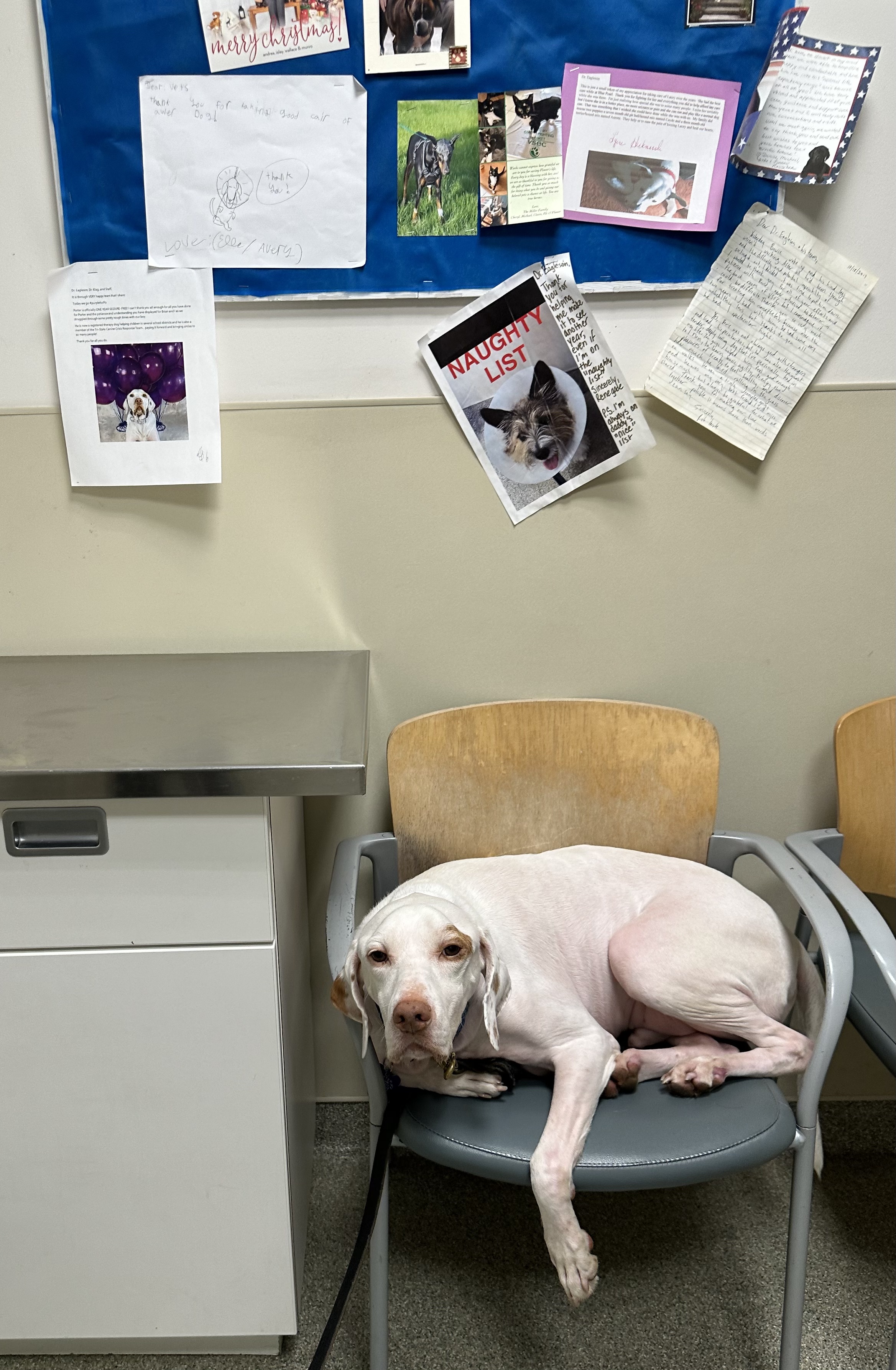
While waiting in Dr. Eagleson’s office, we saw Porter’s 1 Year Seizure Free picture hanging on the bulletin board!
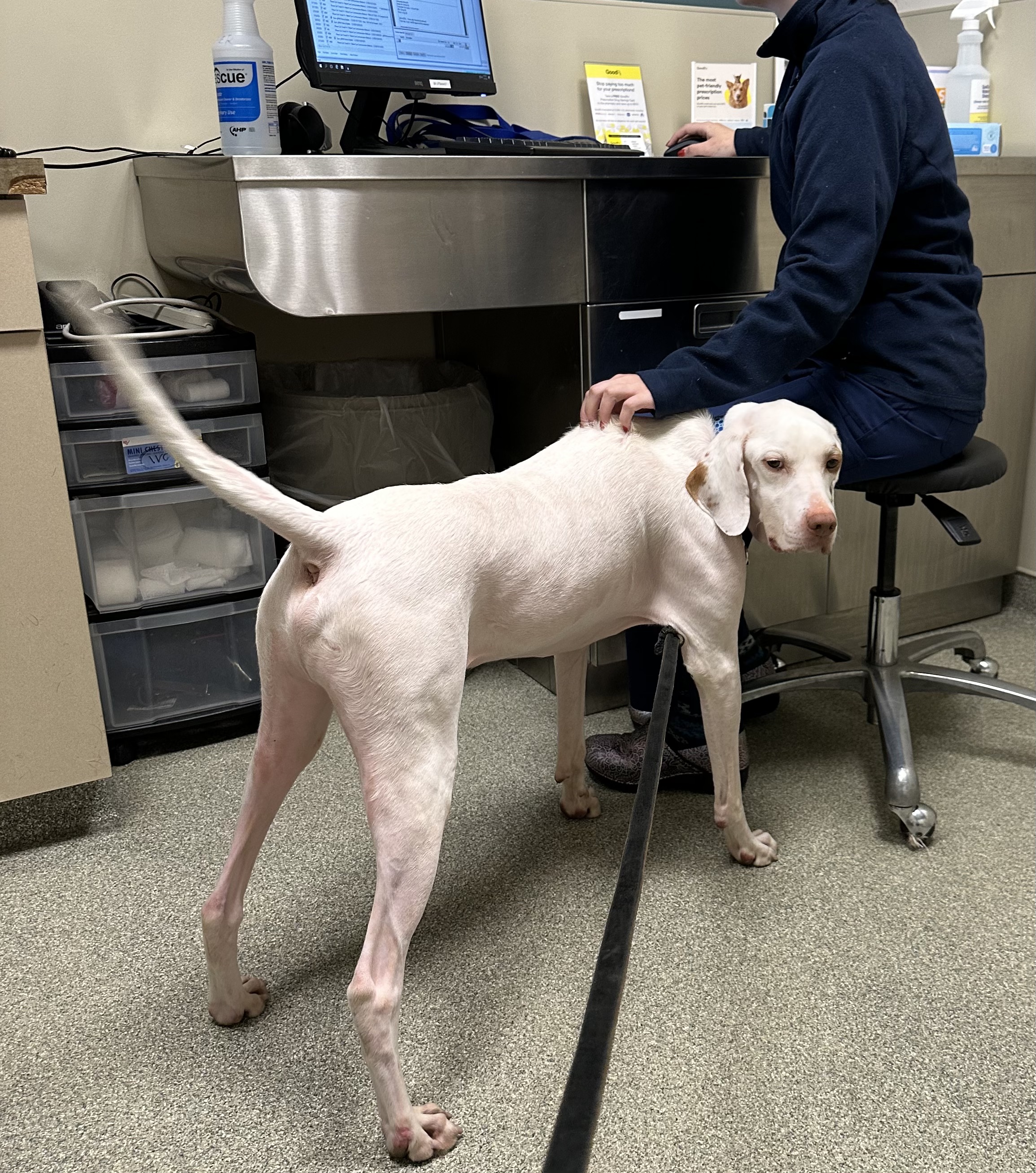
Getting back scratches while the nurse inputs his information for Dr. Eagleson
Waiting for Dr. Eagleson
Dr. Eagleson said that overall Porter looked great and did not have any changes from his last exam.
Physical Exam:
General: Bright, Alert, Responsive
Eyes/Ears/Nose/Throat: No significant findings
Heart/Lungs:
No murmur detected
Lungs clear
Strong synchronous pulses
Abdomen: No masses found
Urogenital / Rectal exam: Within normal limits
Peripheral lymph nodes: Within normal limits
Integument: diffuse symmetrical alopecia (mainly on extremities)
Musculoskeletal:
Body Condition Score: 5/9
head muscle atrophy
Neurological Exam:
Mentation: Bright, Alert, Responsive
Gait: Very mild UMN tetraparesis / general proprioceptive deficit ataxia (appears to be drug related)
Reflexes:
Normal withdrawal in all limbs
Normal patella bilaterally
Normal perineal reflex
Postural Reactions:
Very mild delay in hopping in pelvic limbs
Normal thoracic limbs
Normal placing in all limbs
Cutaneous nerves: Normal
Cranial neves: Normal
Sensory: No pain on spine palpation or neck range of motion
Neuroanatomic Localization: Normal exam
Overall Dr. Eagleson was pleased with Porter’s current seizure control so no changes to his medications will be made at this time.
It was recommended that Porter have a CBC and chemistry profile done. Dr. Eagleson was pleased with all the lab results.
Porter will have his Bromide level checked in March of 2024 and see Dr. Eagleson again in November of 2024.
Note: this post is back-dated. I am currently attempting to catch up on many missed memories that I failed to post over the last 2-3 years). I appreciate your patience as I attempt to bring my diary of “special moments with my dogs” up-to-date!
Dear Epilepsy,
You may be a part of our boy, but you surely don’t define him.
You 𝑎𝑙𝑚𝑜𝑠𝑡 succeeded in the battle you picked with Porter. After recovering fully from his Status Epilepticus episode, not only did he 𝕎𝕀ℕ, he is thriving and paying it forward by helping others.
Porter is proving to the world that dogs with Epilepsy not only can can have a good quality life, but can also beat you at your game and 𝔽𝕃𝕆𝕌ℝ𝕀𝕊ℍ. You are 𝐧𝐨 𝐦𝐚𝐭𝐜𝐡 for our boy’s resilience.
Our efforts: Relentless.
Our faith and hope: Endless.
We won’t give up. We won’t give in…𝑬𝑽𝑬𝑹.
*********************************
We are beyond grateful to be able to celebrate these days with our boys, and fully understand that there are dogs and families who are less fortunate. We will continue to fight each and every day for the warriors of the past and present in hopes that one day all dogs can live seizure-free.
Note: this post is back-dated. I am currently attempting to catch up on many missed memories that I failed to post over the last 2-3 years). I appreciate your patience as I attempt to bring my diary of “special moments with my dogs” up-to-date!
March 26th is Epilepsy Awareness Day (Also known as Purple Day). This day aims to increase everyone’s knowledge of this neurological condition affecting so many people and pups worldwide.
My hope is that through continuously sharing posts about Jägermeister and Porter, I will help change the face of Canine Epilepsy with the intention of dispelling common myths and fears people have about “Epi-dogs.”
Those of you that have been following Porter’s journey know that the path traveled is not always an easy one. There have be numerous rocky roads Po has encountered, but he’s conquered them all. Jägermeister’s journey on the other hand has been much less challenging. Regardless of the course the dog’s epilepsy chooses, the incredible bond that is formed between these pups and their humans is unmatched.
Epilepsy does NOT hold a dog back from enjoying life. Jägermeister competes and excels in dock diving, holds several trick and obedience titles, runs 5k’s, and hikes. Porter loves walking, hiking, visiting dog friendly establishments, and going for rides in his bike cart… and he’s signed up for his first official Fast CAT this April!
Sharing is caring and knowledge is key… so learn more about Epilepsy, know the signs of a seizure and what to do, and spread the word that despite a diagnosis of Epilepsy, a dog can live a healthy and happy life. As the awareness about Canine Epilepsy increases, so does the number of “Epi-dogs” that will be saved!
Join the Purple Day movement:
Learn more about epilepsy.
Show your support by wearing purple.
Donate to research on epilepsy.
Know the signs of a seizure and what to do.
Epilepsy impacts the central nervous system causing seizures and other symptoms. The types of seizures vary depending on the cause and type of epilepsy. Seizures can range from mild “partial” or “focal” seizures to generalized “tonic-clonic” or “grand mal” seizures.
Although in some cases a cause may not ever be found, some known causes of epilepsy include:
November is National Epilepsy Awareness Month. During this month, the goal is to educate and raise awareness about one of the least understood of all neurological diseases.
Our fellow EpilepsyWarrior and IG friend, Rosie the Labradoodle ‘s Mom, published a great journal for PAWrents of dogs with epilepsy. This journal is an efficient way to document your epilepsy warrior’s information, log seizure activity, track medications, triggers, appointments and medical history. The journal measures 7×10 inches and makes traveling with your epileptic pet easier in the event of an emergency trip to the vet by having all of your pet’s medical history in one convenient place. Over 125 epileptic canine warriors are pictured throughout… including OUR very own warriors, Porter and Jägermeister (can yo spot them on the page below?! This journal can be purchased on Amazon.
Epilepsy? What’s That?
“Epilepsy” is a general term for neurological disorders that are characterized by recurrent seizures. In some cases, the seizures are caused by trauma, a toxin, a brain tumor, an infection, or an issue with your dog’s blood, kidneys, or other organs. At other times, the epilepsy is referred to as “idiopathic,” which simply means that there is no identifiable, underlying cause.
Seizures commonly fall into two categories: generalized (grand mal) or partial (focal). Generalized seizures commonly appear as involuntary jerking or twitching movements of all four limbs with loss of consciousness. Partial seizures may involve one limb, side of the body, or face. Partial seizures may progress to generalized seizures. Seizures may also result in abnormal behavior, vocalization, salivation, chomping/chewing, and involuntary urination and defecation.
Dogs with idiopathic epilepsy typically have their first seizures between the ages of 6 months to 6 years. Though idiopathic epilepsy can occur in any breed, it is considered an inheritable disease in many breeds and in some breeds a genetic basis has been identified. Therefore, dogs diagnosed with idiopathic epilepsy should not be used for breeding. Commonly affected breeds include:
Labrador retrievers
Golden retrievers
Poodles
Keeshonds
Beagles
German shepherds
Dachshunds
Irish setters
Cocker spaniels
Is a seizure painful or dangerous to the dog?
Despite the dramatic and violent appearance of a seizure, seizures are not painful, although the dog may feel confusion and perhaps panic. Contrary to popular belief, dogs do not swallow their tongues during a seizure. If you put your fingers or an object into its mouth, you will not help your pet and you run a high risk of being bitten very badly or of injuring your dog. The important thing is to keep the dog from falling or hurting itself by knocking objects onto itself. As long as it is on the floor or ground, there is little chance of harm occurring.
A single seizure is rarely dangerous to the dog. However, if the dog has multiple seizures within a short period of time (cluster seizures), or if a seizure continues for longer than a few minutes, the body temperature begins to rise. If hyperthermia (elevated body temperature) develops secondary to a seizure, another set of problems need to be addressed.
Symptoms
Prolonged seizures lasting more than 5 minutes or two or more consecutive seizures without full recovery are referred to as status epilepticus. This is a true emergency and you should seek immediate veterinary care for your pet. Two or more seizures in 24 hours are referred to as cluster seizures and are an indication for beginning anti-seizure medication.
In dogs, seizures often occur in three distinct phases:
The first is called the aural phase and the most common signs are behavioral changes. These changes may be subtle and include restlessness, attention seeking or anxious behavior.
The second phase, called the ictal phase, is when the seizure itself takes place. A seizure can last from just a few seconds to several minutes.
The final phase is called the postictal phase, which occurs after the seizure. During this phase, your dog may seem restless, uncoordinated and/or disoriented. Occasionally, temporary blindness, deafness or other neurologic abnormalities may occur.
It may be difficult to watch your pet have a seizure but most are of short duration and cause no permanent harm. Avoid being bitten by keeping your hands away from your pet’s mouth during a seizure. If it can be done safely, provide padding and move your pet away from stairs to prevent injury.
Diagnosis
Your veterinarian will take a complete history and perform a thorough physical and neurological exam to determine if there is an identifiable, underlying cause of your dog’s seizure.
In order to do so, the following tests may be recommended:
Chemistry tests to evaluate kidney, liver, and pancreatic function, as well as sugar levels and electrolytes
A complete blood count to screen for infection, inflammation, anemia, and other blood-related conditions
Urinalysis
PCR testing and/or serology to evaluate for infectious diseases that may cause seizures
Referral to a neurologist for advanced testing including MRI and cerebrospinal fluid analysis
Cultures, PCR testing, and other specialized tests that can identify if specific parasites or diseases could be the cause
Treatment
Epilepsy cannot be cured, but it can usually be controlled with anticonvulsant drugs. If your veterinarian determines that your dog’s epilepsy is idiopathic, one or more of the following medications may be prescribed:
Phenobarbital helps reduce the frequency of your dog’s seizures and is the most prescribed medication for dogs with idiopathic epilepsy. It is generally a well-tolerated drug.
Potassium bromide is another seizure medication that may be added to your dog’s treatment, if she does not respond well to phenobarbital alone.
Levetiracetam (Keppra)
With these medications, as with all drugs, some patients experience side effects. In order to make sure an adequate dose is being given, and to monitor for side effects, it is important that blood levels of each medication as well as complete blood counts and blood chemistry profiles be monitored periodically. Liver function tests may also be indicated. Your veterinarian will advise what monitoring needs to be done and how often. Medication dosages should not be changed without talking to your veterinarian.
Dogs diagnosed with idiopathic epilepsy may require treatment for life, and sometimes more than one drug is needed for adequate seizure control. And while many dogs are well controlled, some are not despite multiple medications. In addition, adequate seizure control does not necessarily guarantee that a dog will be entirely seizure free. The degree of seizure control may need to be balanced against potential side effects of the medications.
Management
Besides medication, there are many ways for you, yourself, to help manage your pet’s epilepsy:
Maintain a seizure log that lists date, time, length and severity of seizures as well as videotape and share this with your veterinarian
Do not change or discontinue medications without consulting your veterinarian
Have blood work and other lab work done when recommended by your veterinarian
Consult your veterinarian whenever you notice a change in your pet’s condition
Put a medical alert tag on your pet’s collar so that if he becomes lost, whoever finds him will be aware of their seizure disorder and need for medication.
Several treatments are available for pets with epilepsy. By working closely with your veterinarian, you can maximize the chances of controlling the disorder and giving your pet a long, happy, and comfortable life.
As a pet owner, seeing your dog have a seizure can be one of the most frightening experiences you’ll have. Seizures are often sudden, seemingly occur without reason and leave you feeling helpless as the owner.
There are a variety of different types of seizures found in dogs. However, one very important type of dog seizure to be aware of is cluster seizures.
What are the types of seizures in dogs?
Unfortunately, there are actually several different types of seizures found in dogs, and they can vary greatly in severity. It’s valuable to be able to differentiate the different types of dog seizures so you can have an idea of what type of treatment and outcome to expect.
Epilepsy in Dogs
Believe it or not, epilepsy itself is actually NOT a type of seizure, rather a condition that often causes repeated bouts of seizures. The term “epilepsy” refers to recurrent seizures that originate in the brain. There are different forms of canine epilepsy as well, but again, these are not types of seizures themselves.
Grand Mal Seizures
In a generalized seizure, the dog will fall, lose consciousness, and extend his limbs out rigidly. The dog may also have sudden apnea, meaning he will briefly stop breathing. This will generally last for around 10 to 30 seconds. Afterwards, the dog will begin paddling his limbs or start chewing. He may also have dilated pupils, salivate, urinate or defecate.
Mild Seizure
A mild seizure begins the same way as a grand mal seizure but will typically not involve the extension of the limbs or paddling. The dog usually will not lose consciousness. Mild and grand mal seizures are most often associated with epilepsy.
Petit Mal Seizure
Also known as an absence seizure, petit mal seizures are very rarely recognized in dogs. These seizures are very brief, lasting just seconds, and can manifest as a brief period of unconsciousness, loss of muscle tone, blank stare, or possibly even an upward rotation of the eyes.
Partial Seizure
During a partial seizure, the associated movements will only be seen in one area of the body. This can be the movement of one limb, a muscle jerking, a turning of the head or bending the trunk to one side or even facial twitches. Partial seizures can progress to generalized seizures and are associated with secondary epilepsy.
Complex Partial Seizures
These seizures are notable for the strange or complex behaviors that they repeatedly cause. In humans, complex partial seizures cause us to distort our thought perception, and certain emotions, like fear.
When they happen to dogs, they might be displayed as lip-smacking, chewing, fly biting, aggression, vocalization, frightened running, covering or hiding. Dogs may also experience vomiting, diarrhea, salivation, blindness, unusual thirst or appetite or biting.
These can last minutes or even hours, and can be followed by or progress to a generalized seizure. Like partial seizures, complex partial seizures are also closely associated with secondary epilepsy.
Status Epilepticus
Colloquially known as simply “status,” this type of dog seizure can occur either as a series of multiple seizures within a short timeframe with no periods of normal consciousness in between, or as one continuous seizure that can last up to 30 minutes.
Although closely related to primary and secondary epilepsy, status can sometimes occur suddenly in dogs that have no history of seizures or brain injury. Status can often be difficult to differentiate from cluster seizures. These seizures are considered life-threatening emergencies.
Cluster Seizures
Cluster seizures in dogs occur when a dog experiences multiple seizures within a short period of time, generally considered within a 24-hour window. Like status epilepticus, cluster seizures should be considered life threatening. These seizures are typically brief and isolated, but can also be more serious. Large breed dogs tend to be the most susceptible to cluster seizures.
When a dog experiences cluster seizures, he will usually have one, seem to recover, and then have another a few hours later. However, the dog never fully recovers from the first seizure before the second strikes. This can continue on and on until the dog is in critical condition. With the aforementioned status epilepticus, these seizures won’t be spread out, but will be one long seizure that doesn’t stop. Both are true emergencies.
Cluster seizures can be managed with medication, but the cause of the seizures must first be established before any medication can be prescribed.
What causes cluster seizures in dogs?
Cluster seizures in dogs are often caused by a problem in the dog’s brain, such as a tumor that interferes with the communication between parts of the brain. They can also stem from a lack of oxygen in the brain, low glucose level in the blood, known as hypoglycemia, or hypothyroidism, which is a deficit of thyroid hormone production.
If the seizures seem to happen for no apparent reason, then idiopathic epilepsy may be the cause. This type of epilepsy is difficult to detect because it leaves no lesions or lasting damage on the brain. Genetics can also be a factor in dogs having seizures, but this is not yet absolutely proven.
What dogs have cluster seizures?
Any dog of any age and breed can experience cluster seizures, but they are most often seen in middle-aged dogs. Breeds like Border Collies, Cocker Spaniels, Dachshunds, German Shepherds, and Boxers are known to be susceptible. Research has actually shown that male dogs are more prone to cluster seizures than females.
What are the symptoms of seizures in dogs?
It’s important to note that most seizures are brief, and that your dog can live a normal life when given the proper dog seizure treatment. However, cluster seizures are much more serious, and can cause serious brain damage, or worse.
A dog experiencing a seizure will most often suddenly collapse, exhibit abnormal movement in its limbs, excessive drooling and uncontrollable jaw movement, as well as incontinence. The dog will usually be unconscious and unresponsive, and have no control over its spasms.
In cluster seizures, the dog will seem to recover between seizures, although he will be very tired and lethargic, potentially even staggering, as seizures are exhausting events.
Though their demeanor will otherwise seem fine, they do not fully recover in between seizures and can get progressively worse. If they don’t regain consciousness at all, or seem to have a prolonged seizure lasting up to 30 minutes, this is not a cluster seizure, but status epilepticus, which is extremely dangerous to your dog and can be life threatening.
How are cluster seizures diagnosed?
Dogs that have encountered cluster seizures should be brought into the veterinarian immediately. Once there, your vet will give your dog a glucose test. Often, your vet will also test to see if your dog has ingested poison.
A lot of the diagnosis will come down to what you are able to report to your vet when you bring your dog in. Pay attention to the symptoms your dog displayed during, before, and after a seizure. If you suspect cluster seizures, tell your veterinarian why and that will help them make a proper diagnosis.
Your vet may also conduct a CT scan or an MRI to see if there are any brain tumors or lesions. Since cluster seizures are so serious, you can expect a full round of testing.
How to Treat Cluster Seizures in Dogs
Medication will be prescribed by your veterinarian in order to treat a dog that is experiencing cluster seizures, but there are also a few things you can do at home to help care for your pet.
If you happen to notice your dog having a seizure, you can spring into action if necessary. Make sure your dog isn’t near anything sharp or close to stairs. Note your dog’s behavior during the seizure and, if possible, try to pinpoint the trigger. Comfort your dog after the seizure and see your vet immediately, especially if another seizure occurs.
If your dog has had cluster seizures, you should also be sure to monitor his other bodily functions. Things you’ll want to monitor include:
Packer, R, “Risk Factors for Cluster Seizures in Canine Idiopathic Epilepsy.” Current Neurology and Neuroscience Reports, Apr. 2016, Accessed 1 April 2017. www.ncbi.nlm.nih.gov/pubmed/27033922.
Porter being a ridiculous attention hog as usual while the Tech takes notes for Dr. Eagleson
Summary of The Last Year
Porter has not had any seizure activity for the past year (440 days to be exact)! However, added to his laundry of health issues, Porter was diagnosed with Atypical Addison’s disease this past year. Most recently, he was also diagnosed with hypothyroidism in October. Once Porter was started on prednisone following his Addison’s disease diagnosis, he became a lot more alert and coordinated and his daily “twitching” (which was thought to be focal seizure activity) also subsided.
Neurological Exam Summary
Porter’s neurologist, Dr. Eagleson, thought Porter looked great and is pleased with his current seizure control. Dr. Eagleson would like us to try reducing the CBD to once a day. In regards to his anti-epileptic drugs, Dr. Eagleson said that since his seizure control has been so good, it may be worth trying to reduce some of his daily drugs. That being said, Porter seems to be tolerating all of the medication well. Dr. Eagleson also said he would be ok if we did not want to tempt fate. Since Porter has just begun the thyroid medication, Dr. Eagleson recommended that we wait about three months before making a decision about reducing any anti-epileptic medication. If it is decided to reduce meds, then we would likely start with tapering his Topiramate.
Next Exam
If Porter continues to do well, he will have his next neurological exam in one year.
Note: this post is back-dated. I am currently attempting to catch up on many missed memories that I failed to post over the last 2-3 years). I appreciate your patience as I attempt to bring my diary of “special moments with my dogs” up-to-date!
Purple for Po!
Today Porter is officially ONE YEAR SEIZURE-FREE!! … I don’t even have the words! August 24, 2021 was the last day Porter had a seizure. I am beyond thrilled for this boy and so grateful for every day I have with him! He is truly an AMAZING soul! Thank you to his primary veterinarian, Dr. Campbell at Old York Veterinary Hospital, his neurologist, Dr. Eagleson & international medicine specialist Dr. Klag ( both Blue Pearl / Levittown, PA) without you all, Porter would not be with us today.
It has taken me 11 months to write this post, as it is a recap of one of the scariest days (and couple of weeks) we’ve ever had with our pups.
November is Epilepsy Awareness Month. For those of you who may just be joining our pack’s adventures, our 4-ish-year-old English Pointer, Porter, suffers from severe clustering Grand Mal and Focal seizures caused by idiopathic epilepsy. Eleven months ago, Porter almost lost his battle with this horrible disease when he experienced Status Epilepticus (SE) – a cluster of seizures lasting 5-minutes or more in which the dog does not return to “normal” in between seizures. If it is even possible for something positive to result from Covid, it is that both Brian and I were working from home at the time of Porter’s SE. Had we not been present for this SE episode, Porter would have seized to death.
December 22, 2020
At 8:44am, Porter began to seize. Porter’s seizures had become a regular…almost “normal?” event in our family. We acted quickly, but calmly, because we were prepared with Porter’s seizure protocol and armed with emergency injections. If he clusters, we give him the shot…end of seizures, right? Not this time. When we saw that he was clustering, Brian administered Porter’s emergency injection of Midazolam. However, despite giving the injections, this time, the seizures kept coming. The seizures were severe, emerging one-after-the-other, Porter was violently convulsing and was extremely vocal… it was one of the most awful things I have had to force myself to watch. Brian had given Porter the maximum number of emergency injections allowed with no success in stopping the clustering. Helpless doesn’t even begin to describe how we felt. Porter was then rushed to the emergency hospital.
We were informed that Porter was experiencing Status Epilepticus (SE), and that it was critical to act quickly because neurologic damage continues to occur until seizure activity has ended. The emergency facility was still not allowing clients inside because of Covid, so Porter was taken into the hospital, immediately admitted to the ER and placed on an IV with anesthesia. Standard procedure for a SE is for the dog to be placed on an IV catheter in order to administer anti-epileptic drugs (AEDs). Dogs are usually heavily sedated with anesthesia while receiving AED treatment. While this treatment is being administered, there are several risk factors:
Hypertension, and then hypotension – and both can worsen with addition of AEDs, so closely monitoring blood pressure is extremely important
Hyperthermia – temperature must be closely monitored and cooling efforts are often needed. After seizure activity stops, if the dog has been heavily sedated, hypothermia may occur, and warming may be needed at that time.
Difficulty with upper airways – gag reflex has to be monitored. If the dog is unresponsive, or if the gag reflex is insufficient, it may be necessary to intubate the dog to help prevent hypoxemia and protect the dog’s airway from aspiration.
We were told Porter’s prognosis was poor – as less than 25% of dogs who experience SE will not survive the hospital discharge. Given his current state, euthanasia was also suggested as an option. We refused to even acknowledge this as a choice for Porter until we could more clearly determine what his quality of life would be …IF he survived once he came off the IV.
Porter survived the IV procedure. However, once taken off the IV, the doctors reported that Porter had lost both his sight and the ability to walk (common for dogs who experience SE). Some dogs who are lucky enough to survive the AED therapy make a partial recovery, some dogs make a full recovery, and others remain disabled. Only time would tell for Porter. If he did not recover enough from this point to have a good quality of life, we knew we would have to help him cross over the rainbow bridge.
We were not able to visit with him during his hospital stay due to Covid restrictions. Although it was excruciating not to be there with Porter, the ICU staff kept us updated with photos and video of our boy.
December 23, 2020
In just over 24 hours, Porter’s vitals and response to medications were enough to convince the doctors that he had a fighting chance and could be released from the hospital. The days that followed Porter’s return home felt like an eternity as we watched for signs of improvement, indications of decline, and additional seizures.
When we brought Porter home, he laid motionless on the dog bed- eyes glazed over. I have to admit – after seeing him in this state, I began to prepare myself for having to say goodbye to him. The last thing we ever want is a poor quality of life for any of our fur-kids.
January 5, 2021
However, slowly but surely, over the next two weeks, Porter began to show improvement! His eyesight began to return, he was able to pick his head up… then sit up… then stand up…then walk!
As we celebrated his recovery, we also had to decide along with Porter’s neurologist and primary veterinarian, what to do from here. Although in the past, Porter did not respond well to Potassium Bromide, it suggested that we add this back in to his complex cocktail of medications. We believe that addition has played a major role in his recovery and our goal of aiming for zero.
Fast forward to November 2021
Porter went from having a seizure every seven to fourteen days… battling Status Epilepticus (and winning!)…to only having two seizures (one mild Grand Mal, and one mild Focal) in the past 11 months! To say we are thrilled is an understatement. Porter goes on walks, runs in the yard, plays with toys, and partakes in shenanigans with his siblings. He’s happy and loves spending time with any human or dog that will pay him some attention! He is an amazing warrior! At the same time, we know full well that Porter’s battle is far from over. The life span of dogs who experience SE is drastically shortened. In addition, the amount of medication Porter is taking can harm other organs, and also dramatically reduces the other drugs he can take that may help him battle other illnesses and diseases.
November 8, 2021
Porter had his annual neurological evaluation at BluePearl Pet Hospital. Overall, his neurologist is pleased with Porter’s recovery and current status. However, in recent routine blood test, Porter’s Bromine level was a bit high at 3.4 (normal is 1-3 mg/mL). Adjusting his Potassium Bromide dose at this point could put Porter back into an undesirable seizure cycle again, so his neurologist is reluctant to decrease the dose at this time. Porter’s liver panel displayed that his Albumin level was low at 1.8 g/dL (normal is 2.7 – 3.9). His low Albumin is not thought to be related to his abnormal Bromide level. However, we need to find out where Porter is losing protein – the cause of the low Albumin level. A urinalysis was done and came back normal. So now he will have a Fecal Alpha Proteinase Inhibitor test to rule out any gastrointestinal disorders that may be causing Porter to lose proteins. Porter will be monitored closely while the additional fecal testing is underway and discussions among his medical team are conducted.
In the mean time, we will continue to aim for zero as we celebrate each and every day with this very special and amazing soul.
Please help us spread Epilepsy Awareness by sharing Porter’s story.
This is a log of Porter’s Seizure activity to provide a summary of how often his seizures occur, what types of seizures he has, and how long it has been since the last seizure.
Every dog’s seizures may look different, especially depending on what kind of seizure your dog has. Porter has had Grand Mal, clustering Grand Mal, Focal, and clustering Focal seizures. During Porter’s Grand Mal seizures, he has violent convulsions, and often foams at the mouth, clenches his jaw down on an object, urinates, defecates, or vomits. He is unaware during his this type of seizure. During Porter’s Focal seizures, he is very much aware, and looks to us for comfort. Porter’s Focal seizures cause him to have facial and ear twitching, full body twitching, and balance issues during or immediately following the Focal seizure.
I highly recommend using a camera that offers movement/sound notifications and constant record/play-back to monitor your dog while you are not home. There are many brands of cameras out there. However, after researching, we chose to use Google Nest cameras in our home and on our camper. This will allow you to get notified that your dog may be in danger, and also will enable you to save clips of your dog’s seizures to share with your dog’s medical team. I also encourage others to video the seizure when safely possible if the seizure happens while you are home so that you have actual footage to share with your dog’s doctors.
Seizure Log:
1/2/2019
3 am / Grand Mal
1st observed seizure
CBC
Full Chem
Urinalysis
fecal
2/26/2019 (55 days from last seizure)
1:50 am / Grand Mal / 30 seconds
5:10 am / Grand Mal /50 seconds
3 hours, 20 minutes from last seizure
Hospitalization required
started medication: Levetiracetam (Keppra)
5/8/2019 (71 days from last seizure)
1:48 am / Grand Mal / 5 minutes
1:57am / Grand Mal / 1 minute, 45 seconds
Hospitalization required
Porter was prescribed Midazolam injections for us to have on-hand for emergencies when Porter cannot come out of seizures on his own
5/26/2019 (18 days from last seizure)
2:30 am / Grand Mal / 30 seconds
Midazolam injection required
Medicine Change: Added Zonisamide
6/15/2019 (20 days from last seizure)
9:55 am / Grand Mal / 40 seconds
Midazolam injection required
7/9/2019 (24 days from last seizure)
2:15am / Grand Mal / 45 seconds
2:16 am / 30 seconds
2:17 am / 45 seconds
Medication change: Weaned off of Keppra / Started Phenobarbital
7/28/2019 (19 days from last seizure)
6 am / Grand Mal / 50 seconds
Medication Adjustment: Increased Phenobarbital
Started Melatonin at night
8/11/2019 (14 days from last seizure)
9:44 pm / Grand Mal / 32 seconds
8/13/2019 (30 hours since last seizure)
4:11 am / Grand Mal / 32 seconds
Medicine Change: Added Potassium Bromide
8/28/2019 (15 days since last seizure)
7:46 am / Grand Mal / 30 seconds
9/17/2019 (20 days since last seizure)
8:15 am / Grand Mal / 31 seconds
8:17 am / Grand Mal / 46 seconds
8:18 am / Grand Mal / 40 seconds
8:19 am / Grand Mal / 1 minute, 4 seconds
Midazolam injection required
8: 22 am / Grand Mal
8:23 am / Grand Mal
Hospitalization required
Medicine adjustment: Reduced Potassium Bromide
10/1/19
MRI
no abnormalities found
10/11/19 Medicine change: Added Gabapentin in evening
used as anti convulsant and also to help Porter sleep since he was not sleeping much through the night
10/14/2019 (27 days since last seizure)
1:04 pm / Grand Mal / 40 seconds
1:06 pm / Grand Mal / 49 seconds
1:20 pm / Grand Mal / 41 seconds
Midazolam injection required
11/1/2019 (18 days since last seizure)
11:14 pm / Grand Mal / 30 seconds
Medicine Change: Weaned-off Potassium Bromide and Phenobarbital. Reintroduced Keppra
Porter’s neurologist expressed that despite the medication changes, Porter is still having the same or similar cycles of seizures. However, due to the increased and severe anxiety that we observed, he feels it is best if we backed him off of both the phenobarbital and potassium bromide. He also feels that re-introducing Keppra again may be the best alternative since the anxiety and behaviors were not noted while he was on this medication.
11/11/2019 (10 days since last seizure)
8:49am / Grand Mal / 30 seconds
8:51 am / Grand Mal / 40 seconds
Medicine Change: stopped Gabapentin at night and started Trazadone
11/23/19
began CBD oil (Charlotte’s Web brand)
12/5/19 (24 days since last seizure)
10:51 am / Grand Mal / 30 seconds
10: 52 am / Grand Mal / 30 seconds
12/30/19 (25 days since last seizure)
9:58 am / Grand Mal / 38 seconds
9:59 am / Grand Mal / 10 seconds
10:00 am / Grand Mal / 51 seconds
1/28/20 (29 days since last seizure)
1:15 am / Grand Mal / 20 seconds
1:17 am / Grand Mal / 30 seconds
1:18 am First observation of what we thought was Focal seizures
1/29/20 (43 hours, 25 minutes since last seizure)
8:40pm clustering focal seizures / Clustering until 10pm
Acupuncture, an ancient Chinese practice of inserting thin sterile needles into specific points in the body, has been known to be effective in treating dogs with epilepsy. After numerous unsuccessful drug trials, we decided to give acupuncture a try for Porter, along with supportive Chinese herbs. In July of 2020, we were referred to Dr. Karen Collins, VMD.
I despise needles and will pass out if I need to have blood taken, so I was extremely nervous to try acupuncture with Porter. A phone call with Dr. Collins’ nurse set my mind at ease. I learned that there is no pain when the needles are placed in the dog’s skin, and that most dogs will even become very relaxed during the session.
Porter’s First Acupuncture Treatment
During the initial visit, Dr. Collins reviewed Porter’s history, performed a physical examination and a discussed Porter’s individual needs. She created an individualized treatment plan which included acupuncture, Tui-Na and Chinese herbs. Porter also had his first acupuncture treatment.
Herbal Medicine
Porter’s plan included incorporating:
Di Tan Tang
Tian Ma Bai Zhu
In addition to the above Chinese herbs, Porter also began taking Neurotrophin PMG supplement. Neurotrophin PMG helps to support healthy central nervous system function. We did not discontinue or alter his traditional anti-seizure drugs during this time.
Dr. Collins also provided me with the following information about Chinese herbal medicine:
Chinese herbal medicine uses herbal formulas, which are groups of herbs that work together synergistically. Many of the herbal formulas have been in use for hundreds and even thousands of years. The many constituents in the herbal formula are present in small amounts, but work together. Side effects are possible, but happen uncommonly, especially when the herbal formulas are prescribed by a trained herbalist. If adverse events occur, they are generally very mild and limited to gastrointestinal upset. I tend to start all herbal medicines at a low dose and slowly increase the dose and this avoids almost all GI problems. Herbal formulas work physiologically, not pharmacologically. The appropriate herbal formula is chosen based on a Chinese medical diagnosis. We now also have large amounts of information about the biochemistry of the individual herbs and formulas and their mechanisms of action. Depending on the formula, it may increase blood flow to particular tissues or organs, have anti-inflammatory effects, help resolve chronic inflammation, relieve pain, slow and prevent degenerative processes, support digestion, normalize smooth muscle contraction, act as an immune modulator, have anti-microbial effects, and/or control cancer growth. When herbal medicines are used to help treat patients with cancer, the herbal medicines act through many possible mechanisms and most individual herbs act in several places in the cascade of events that allows cancer cells to thrive. Herbal medicines can be integrated into a western medical protocol or used on their own.
Therapeutic Massage
Tui-Na (Chinese healing massage) was also introduced and the following directions were given:
For this particular massage, use gentle touch. Think of yourself as only touching your pet’s fur and skin. This is not a deep tissue massage.
Use your pointer finger on their midline (spine), thumb and middle finger on either side.
Start at the top of their head at the little smart bump.
Slide your hand from the top of their head, down their back, to the base of their tail. Allow your pointer finger to follow the midline or spine, your thumb and middle finger on either side.
Repeat 5 or 10 times.
Then, continue down the back of one or both hind legs. Work on the leg that is easier to reach.
Find the back of their knee (stifle) and massage right where the knee bends.
From there, you will find their ankle. There is a fleshy area located between a bone and a tendon. Massage that area above the ankle (hock) with your pointer finger on one side and your thumb on the other side, gently.
For the last leg point, you will simply slide down and rub up against the large pad.
Porter is not the typical case for sure. He has trialed many things that have been reported to help dogs with epilepsy. Almost everything we have tried has not made a difference for out boy. Although we learned so much from Dr. Collins, the acupuncture was not beneficial in reducing Porter’s seizure frequency or severity, so we stopped treatment in October of 2020.
Recommended Books
Chinese medicine had many benefits for illnesses and ailments of all kinds. Want to learn more? Below are two great books recommended by Dr. Collins that I very much enjoyed:
Studies have shown that thermal properties of foods can have in impact on seizure activity. We were told to avoid foods with hot and warming thermal properties for Porter. Below is the list we were provided with. The cooling and neutral foods are best for dogs with epilepsy.
VSH of the Carolinas (**Now BluePearl Pet Hospital) offers nutritional services that may benefit dogs with epilepsy. We decided to try a dietary change in hopes that this would reduce the severity and frequency of Porter’s seizures. VSH provided us with a diet and nutrition support plan that was recommended based on Porter’s medical records, diagnostic results, and dietary history. Consultations can be done online or by making an in-person visit.
We are not sharing the dietary suggestions that we received for Porter, as we truly believe that every dog’s dietary needs are unique and should be discussed with your dog’s medical team.
Nutrition Services Offered by VSH of the Carolinas:
Courtesy pDVM/ colleague commercial recommendations: Based on patients’ clinical problems and diagnostic results, a list of appropriate commercial options is provided via phone or email.
Voluntary commercial consultations: A list of appropriate commercial options are provided to the client with specific feeding guidelines and monitoring parameters.
Weight loss consultation: Individualized weight loss plan provided to the client. Includes bi-monthly weights and check-ins to monitor progress, in addition to addressing any nutrition-related concerns or questions.
Assisted feeding consultation (any type of feeding tube/ port): Based on patients’ disease processes, appropriate liquid diets/ liquid diet blends (for nasoenteric or jejunostomy tubes) or slurried diet blends (esophagostomy or gastrostomy tubes), feeding guidelines, and monitoring parameters are provided. Additionally, commercial options for volitional intake will also be provided (if applicable). If/ when the patient goes home, at-home guidelines will be provided to the client. Direct follow up with the client for any nutrition-related concerns or questions it available.
Homemade diet consultation: Two patient-specific homemade diet recipes are formulated and provided to the client based on the patient’s individual disease states. Specific cooking directions, feeding guidelines, and monitoring parameters are provided. Use of human supplements.
Combination Homemade diet + commercial
Homemade diet analysis: Technical analysis of client’s homemade diet using recipe/ information supplied by the client. Often needed to demonstrate nutritional deficiencies/ excesses in online recipes. Does not include “fixing” the diet to make it appropriate.
Combination homemade diet analysis and reformulation of up to 2 recipes: See option 5+7.
Homemade diet reformulation: In the event that an existing patient with a VSH homemade diet develops new medical problems and a reformulation is required. Ex. Renal disease and then develops pancreatitis; use of human supplements.
Supplement/ nutraceutical evaluation: Using existing medical records and product information, recommendations are made regarding dosing, continuation, and/or discontinuation of supplements.
Commercial diet evaluation: Based on the patient’s medical problems and diagnostic results, evaluation of the appropriateness of current / potential diet is provided.
In person appointment: Discussion of client concerns and goals, nutritional physical exam, etc.
Recommended Commercial Kibble:
Purina Canine NC NeuroCare
Purina Canine Bright Mind Adult 7+ Large Breed
Royal Canin Canine Mobility Support JS Large Breed
Recommended Commercial Wet Foods:
Purina Canine Bright Minds Adult 7+ Turkey and Brown Rice Entrée
Although we learned invaluable information with this nutrition consult, unfortunately, just like many other options we tried, this did not change Porter’s seizure frequency or severity. He was also not a fan of the food. He was transitioned back to his normal diet in October 2020.
November is Epilepsy Awareness Month for both people and dogs. This life-long condition has no cure and is extremely unpredictable, which is why it is important to continue to educate, spread awareness, and support continued research.
Most dogs will show signs epilepsy between the ages of 1-3. It is nearly impossible to know exactly when a dog might have a seizure.
Seeing a dog have a seizure can be very unsettling. The dog may fall over, become stiff, convulse, drool, and become vocal. Dogs may lose control of their bladder and/or bowels and sometimes will also vomit.
Seizure recovery can vary from dog to dog. Some may recover very quickly, and others could take 24 hours or more. After a seizure the dog may be disoriented, pace back and forth, or exhibit extreme thirst.
Epilepsy is a diagnosis of exclusion. Your veterinarian will first need to rule out that your dog doesn’t have a different disease or condition that causes the seizures. The doctor may do blood tests, x-rays, an MRI, and/or a spinal tap. Once the veterinarian rules out the other possible diagnoses, they can conclude that a dog has epilepsy.
Want to learn more? Here are a few informative links:
***This protocol is what we follow for Porter. Please do not follow this protocol without first consulting your dog’s primary veterinarian and/or neurologist.***
******If questioning at all – go to an emergency veterinary service.
Single seizure in a day with no differences or complications
just contact doctors to let them know
Contact Dr. C & Dr. E immediately and go to ER if the following occurs with Porter:
2 seizures within a day
Dogs that have more than one seizure in a 24-hour period are experiencing “cluster” seizures. This requires immediate veterinary attention, and you should take your dog to a veterinary hospital right away for examination
a seizure lasting 3 mins or more
not coming out of seizure at all or having difficulty coming out of it
comes out of one seizure and immediately goes into another
Postictal Phase
If Porter is no longer seizing, we still bring him to the ER if the following circumstances are occurring:
The postictal stage can last up to 24 hours in some dogs. However, if we still see postictal symptoms after 12 hours but no seizures – this warrants a visit to the ER
If Porter comes out of the postictal phase, and then seems to go back into the postictal phase
If Porter is out of the postictal phase and has another seizure
VERY important things to report to a doctor:
clustering
More than one seizure in a day
More than 1 seizure per month
***This protocol is what we follow for Porter. Please do not follow this protocol without first consulting your dog’s primary veterinarian and/or neurologist.***
***Please consult your dog’s primary veterinarian and/or neurologist about choosing the best medication(s) and/or supplements for your dog’s unique needs. Never give your dog a drug or supplement without first speaking to your dog’s medical team***
Not every medication is for every dog with epilepsy which is why it is very important that you carefully consult your dog’s medical team prior to starting any drug or supplement. Every dog can react differently to medicinal and supplemental changes. Porter was on Phenobarbital , Gabapentin, and Potassium Bromide in the past with no success. These drugs did not change his seizure patterns or frequency. In addition, Porter had severe negative medical and behavioral changes in response to these medications. These included:
ataxia
accidents in his crate that he was completely unaware of
dogs who typically have seizures at night or in the early morning can benefit from a small snack and some melatonin before bedtime. The food helps to keep blood sugar stabilized and the melatonin assists in maintaining a regular sleep pattern.
Porter has had extensive testing throughout his battle with epilepsy.
CBC
blood test that provides information about the different cell types in blood
there are several abnormalities on a CBC that might explain seizures
Porter’s CBC was normal
full chem profile
Analyzing various substances (such as proteins, enzymes, fats, sugars, hormones, electrolytes, etc.) provides information about the health of the body’s organs and tissues such as the liver, kidney, and pancreas and aids in detecting diabetes and other metabolic diseases
Porter’s chem profile was normal
urinalysis
evaluates the chemical and physical properties of urine.
necessary for the proper interpretation of the biochemistry profile, especially in a dog that might have seizures due to kidney disease, diabetes, or other metabolic disorders.
Your dog has a seizure… what do you do (or NOT do)?!
These Do’s and Don’ts are just suggestions. As always, what is best for you and your dog should be discussed in detail with your veterinarian. Also, these are not listed in any particular order.
DO:
DO remain calm (as hard as it may seem). This can be difficult, but your dog’s health depends on your ability to focus.
DO contact your vet or bring your dog to the ER if you are questioning in any way if the dog needs medical attention
DO contact your vet and/or bring your dog to the ER if
the seizure lasts more than 3 minutes
your dog has 2 seizures within a day
your dog is having difficulty coming out of a seizure
your dog comes out of one seizure and goes immediately into another
DO time how long your dog’s seizures last and record them in a seizure diary. Knowing when your dog’s seizure started and how long it lasted will give your veterinarian important information about your dog’s symptoms.
DO film your dog’s seizures when safely possible and show the videos to your vet. This will help you time the seizure. It will also assist the doctor in identifying the type of seizure and better equip them to advise you.
DO remove as many sensory stimuli as possible such as turning the television off and turning down the lights
DO try and make sure that your dog is not in a position to injure themselves. Keep them away from stairs, cushion their head if needed (Be sure to keep hands away from the dog’s mouth), and move furniture or dangerous objects, etc. away from the dog
DO monitor your pet closely so he doesn’t injure himself; he will be disoriented and unsure of what is happening.
Don’ts:
DON’T put your hand near your dog’s mouth while it is having a seizure. Do not put your hands near your dog’s mouth or put their tongue back in their mouth. Your dog is unconscious during this time and has no control. You could be badly bitten.
DON’T give your dog additional medication without speaking to your vet first, unless this protocol was already set in place as an action plan by your dog’s medical team
DON’T try to move the dog unless the dog’s safety is in danger (going to fall down stairs, etc)
DON’T try to restrain the dog
DON’T try to give the dog food or water until they are fully alert
1) The pre-ictal phase(aura), is a period of altered behavior in which the dog may hide, appear nervous, or seek out the owner. It may be restless, nervous, whining, shaking, or salivating. This may last a few seconds to a few hours. This period precedes the seizure activity, as if the dog senses that something is about to occur.
2) The ictal phase can last from a few seconds to several minutes, and can vary in appearance. The ictal phase can range from mild changes in mental awareness, such as a dazed look, mild shaking, staring aimlessly, licking lips, to a complete loss of consciousness and body function. If the dog experiences a grand mal, or full-blown seizure with loss of consciousness, all of the muscles of the body move spastically and erratically. The dog usually falls over on its side and paddles its legs while seeming to be otherwise paralyzed. The head will often be drawn backward. Urination, defecation, and salivation may occur. If the seizure has not stopped within five minutes, the dog is said to be in status epilepticus or prolonged seizure (see below).
3) During the post-ictal phase or the period immediately after the end of the seizure, there is confusion, disorientation, salivation, pacing, restlessness, or even temporary blindness. There is no direct correlation between the severity of the seizure and the duration of the post-ictal phase.
As a pet owner, seeing your dog have a seizure can be one of the most frightening experiences you’ll have. Seizures are often sudden, seemingly occur without reason and leave you feeling helpless as the owner.
There are a variety of different types of seizures found in dogs. However, one very important type of dog seizure to be aware of is cluster seizures.
What are the types of seizures in dogs?
Unfortunately, there are actually several different types of seizures found in dogs, and they can vary greatly in severity. It’s valuable to be able to differentiate the different types of dog seizures so you can have an idea of what type of treatment and outcome to expect.
Epilepsy in Dogs
Believe it or not, epilepsy itself is actually NOT a type of seizure, rather a condition that often causes repeated bouts of seizures. The term “epilepsy” refers to recurrent seizures that originate in the brain. There are different forms of canine epilepsy as well, but again, these are not types of seizures themselves.
Grand Mal Seizures
In a generalized seizure, the dog will fall, lose consciousness, and extend his limbs out rigidly. The dog may also have sudden apnea, meaning he will briefly stop breathing. This will generally last for around 10 to 30 seconds. Afterwards, the dog will begin paddling his limbs or start chewing. He may also have dilated pupils, salivate, urinate or defecate.
Mild Seizure
A mild seizure begins the same way as a grand mal seizure but will typically not involve the extension of the limbs or paddling. The dog usually will not lose consciousness. Mild and grand mal seizures are most often associated with epilepsy.
Petit Mal Seizure
Also known as an absence seizure, petit mal seizures are very rarely recognized in dogs. These seizures are very brief, lasting just seconds, and can manifest as a brief period of unconsciousness, loss of muscle tone, blank stare, or possibly even an upward rotation of the eyes.
Partial Seizure
During a partial seizure, the associated movements will only be seen in one area of the body. This can be the movement of one limb, a muscle jerking, a turning of the head or bending the trunk to one side or even facial twitches. Partial seizures can progress to generalized seizures and are associated with secondary epilepsy.
Complex Partial Seizures
These seizures are notable for the strange or complex behaviors that they repeatedly cause. In humans, complex partial seizures cause us to distort our thought perception, and certain emotions, like fear.
When they happen to dogs, they might be displayed as lip-smacking, chewing, fly biting, aggression, vocalization, frightened running, covering or hiding. Dogs may also experience vomiting, diarrhea, salivation, blindness, unusual thirst or appetite or biting.
These can last minutes or even hours, and can be followed by or progress to a generalized seizure. Like partial seizures, complex partial seizures are also closely associated with secondary epilepsy.
Status Epilepticus
Colloquially known as simply “status,” this type of dog seizure can occur either as a series of multiple seizures within a short timeframe with no periods of normal consciousness in between, or as one continuous seizure that can last up to 30 minutes.
Although closely related to primary and secondary epilepsy, status can sometimes occur suddenly in dogs that have no history of seizures or brain injury. Status can often be difficult to differentiate from cluster seizures. These seizures are considered life-threatening emergencies.
Cluster Seizures
Cluster seizures in dogs occur when a dog experiences multiple seizures within a short period of time, generally considered within a 24-hour window. Like status epilepticus, cluster seizures should be considered life threatening. These seizures are typically brief and isolated, but can also be more serious. Large breed dogs tend to be the most susceptible to cluster seizures.
When a dog experiences cluster seizures, he will usually have one, seem to recover, and then have another a few hours later. However, the dog never fully recovers from the first seizure before the second strikes. This can continue on and on until the dog is in critical condition. With the aforementioned status epilepticus, these seizures won’t be spread out, but will be one long seizure that doesn’t stop. Both are true emergencies.
Cluster seizures can be managed with medication, but the cause of the seizures must first be established before any medication can be prescribed.
What causes cluster seizures in dogs?
Cluster seizures in dogs are often caused by a problem in the dog’s brain, such as a tumor that interferes with the communication between parts of the brain. They can also stem from a lack of oxygen in the brain, low glucose level in the blood, known as hypoglycemia, or hypothyroidism, which is a deficit of thyroid hormone production.
If the seizures seem to happen for no apparent reason, then idiopathic epilepsy may be the cause. This type of epilepsy is difficult to detect because it leaves no lesions or lasting damage on the brain. Genetics can also be a factor in dogs having seizures, but this is not yet absolutely proven.
What dogs have cluster seizures?
Any dog of any age and breed can experience cluster seizures, but they are most often seen in middle-aged dogs. Breeds like Border Collies, Cocker Spaniels, Dachshunds, German Shepherds, and Boxers are known to be susceptible. Research has actually shown that male dogs are more prone to cluster seizures than females.
What are the symptoms of seizures in dogs?
It’s important to note that most seizures are brief, and that your dog can live a normal life when given the proper dog seizure treatment. However, cluster seizures are much more serious, and can cause serious brain damage, or worse.
A dog experiencing a seizure will most often suddenly collapse, exhibit abnormal movement in its limbs, excessive drooling and uncontrollable jaw movement, as well as incontinence. The dog will usually be unconscious and unresponsive, and have no control over its spasms.
In cluster seizures, the dog will seem to recover between seizures, although he will be very tired and lethargic, potentially even staggering, as seizures are exhausting events.
Though their demeanor will otherwise seem fine, they do not fully recover in between seizures and can get progressively worse. If they don’t regain consciousness at all, or seem to have a prolonged seizure lasting up to 30 minutes, this is not a cluster seizure, but status epilepticus, which is extremely dangerous to your dog and can be life threatening.
How are cluster seizures diagnosed?
Dogs that have encountered cluster seizures should be brought into the veterinarian immediately. Once there, your vet will give your dog a glucose test. Often, your vet will also test to see if your dog has ingested poison.
A lot of the diagnosis will come down to what you are able to report to your vet when you bring your dog in. Pay attention to the symptoms your dog displayed during, before, and after a seizure. If you suspect cluster seizures, tell your veterinarian why and that will help them make a proper diagnosis.
Your vet may also conduct a CT scan or an MRI to see if there are any brain tumors or lesions. Since cluster seizures are so serious, you can expect a full round of testing.
How to Treat Cluster Seizures in Dogs
Medication will be prescribed by your veterinarian in order to treat a dog that is experiencing cluster seizures, but there are also a few things you can do at home to help care for your pet.
If you happen to notice your dog having a seizure, you can spring into action if necessary. Make sure your dog isn’t near anything sharp or close to stairs. Note your dog’s behavior during the seizure and, if possible, try to pinpoint the trigger. Comfort your dog after the seizure and see your vet immediately, especially if another seizure occurs.
If your dog has had cluster seizures, you should also be sure to monitor his other bodily functions. Things you’ll want to monitor include:
Packer, R, “Risk Factors for Cluster Seizures in Canine Idiopathic Epilepsy.” Current Neurology and Neuroscience Reports, Apr. 2016, Accessed 1 April 2017. www.ncbi.nlm.nih.gov/pubmed/27033922.
“Epilepsy” is a general term for neurological disorders that are characterized by recurrent seizures. In some cases, the seizures are caused by trauma, a toxin, a brain tumor, an infection, or an issue with your dog’s blood, kidneys, or other organs. At other times, the epilepsy is referred to as “idiopathic,” which simply means that there is no identifiable, underlying cause.
Seizures commonly fall into two categories: generalized (grand mal) or partial (focal). Generalized seizures commonly appear as involuntary jerking or twitching movements of all four limbs with loss of consciousness. Partial seizures may involve one limb, side of the body, or face. Partial seizures may progress to generalized seizures. Seizures may also result in abnormal behavior, vocalization, salivation, chomping/chewing, and involuntary urination and defecation.
Dogs with idiopathic epilepsy typically have their first seizures between the ages of 6 months to 6 years. Though idiopathic epilepsy can occur in any breed, it is considered an inheritable disease in many breeds and in some breeds a genetic basis has been identified. Therefore, dogs diagnosed with idiopathic epilepsy should not be used for breeding. Commonly affected breeds include:
Labrador retrievers
Golden retrievers
Poodles
Keeshonds
Beagles
German shepherds
Dachshunds
Irish setters
Cocker spaniels
Is a seizure painful or dangerous to the dog?
Despite the dramatic and violent appearance of a seizure, seizures are not painful, although the dog may feel confusion and perhaps panic. Contrary to popular belief, dogs do not swallow their tongues during a seizure. If you put your fingers or an object into its mouth, you will not help your pet and you run a high risk of being bitten very badly or of injuring your dog. The important thing is to keep the dog from falling or hurting itself by knocking objects onto itself. As long as it is on the floor or ground, there is little chance of harm occurring.
A single seizure is rarely dangerous to the dog. However, if the dog has multiple seizures within a short period of time (cluster seizures), or if a seizure continues for longer than a few minutes, the body temperature begins to rise. If hyperthermia (elevated body temperature) develops secondary to a seizure, another set of problems need to be addressed.
Symptoms Prolonged seizures lasting more than 5 minutes or two or more consecutive seizures without full recovery are referred to as status epilepticus. This is a true emergency and you should seek immediate veterinary care for your pet. Two or more seizures in 24 hours are referred to as cluster seizures and are an indication for beginning anti-seizure medication.
In dogs, seizures often occur in three distinct phases:
The first is called the aural phase and the most common signs are behavioral changes. These changes may be subtle and include restlessness, attention seeking or anxious behavior.
The second phase, called the ictal phase, is when the seizure itself takes place. A seizure can last from just a few seconds to several minutes.
The final phase is called the postictal phase, which occurs after the seizure. During this phase, your dog may seem restless, uncoordinated and/or disoriented. Occasionally, temporary blindness, deafness or other neurologic abnormalities may occur.
It may be difficult to watch your pet have a seizure but most are of short duration and cause no permanent harm. Avoid being bitten by keeping your hands away from your pet’s mouth during a seizure. If it can be done safely, provide padding and move your pet away from stairs to prevent injury.
Diagnosis Your veterinarian will take a complete history and perform a thorough physical and neurological exam to determine if there is an identifiable, underlying cause of your dog’s seizure.
In order to do so, the following tests may be recommended:
Chemistry tests to evaluate kidney, liver, and pancreatic function, as well as sugar levels and electrolytes
A complete blood count to screen for infection, inflammation, anemia, and other blood-related conditions
Urinalysis
PCR testing and/or serology to evaluate for infectious diseases that may cause seizures
Referral to a neurologist for advanced testing including MRI and cerebrospinal fluid analysis
Cultures, PCR testing, and other specialized tests that can identify if specific parasites or diseases could be the cause
Treatment Epilepsy cannot be cured, but it can usually be controlled with anticonvulsant drugs. If your veterinarian determines that your dog’s epilepsy is idiopathic, one or more of the following medications may be prescribed:
Phenobarbital helps reduce the frequency of your dog’s seizures and is the most prescribed medication for dogs with idiopathic epilepsy. It is generally a well-tolerated drug.
Potassium bromide is another seizure medication that may be added to your dog’s treatment, if she does not respond well to phenobarbital alone.
Levetiracetam (Keppra)
With these medications, as with all drugs, some patients experience side effects. In order to make sure an adequate dose is being given, and to monitor for side effects, it is important that blood levels of each medication as well as complete blood counts and blood chemistry profiles be monitored periodically. Liver function tests may also be indicated. Your veterinarian will advise what monitoring needs to be done and how often. Medication dosages should not be changed without talking to your veterinarian.
Dogs diagnosed with idiopathic epilepsy may require treatment for life, and sometimes more than one drug is needed for adequate seizure control. And while many dogs are well controlled, some are not despite multiple medications. In addition, adequate seizure control does not necessarily guarantee that a dog will be entirely seizure free. The degree of seizure control may need to be balanced against potential side effects of the medications.
Management Besides medication, there are many ways for you, yourself, to help manage your pet’s epilepsy:
Maintain a seizure log that lists date, time, length and severity of seizures as well as videotape and share this with your veterinarian
Do not change or discontinue medications without consulting your veterinarian
Have blood work and other lab work done when recommended by your veterinarian
Consult your veterinarian whenever you notice a change in your pet’s condition
Put a medical alert tag on your pet’s collar so that if he becomes lost, whoever finds him will be aware of their seizure disorder and need for medication.
Several treatments are available for pets with epilepsy. By working closely with your veterinarian, you can maximize the chances of controlling the disorder and giving your pet a long, happy, and comfortable life.
If you have any questions or concerns, you should always visit or call your veterinarian – they are your best resource to ensure the health and well-being of your pets.
Some Superheroes Fight Crime, Mine Fights Epilepsy
My Epilepsy Warrior is a 3 year old English Pointer named Porter. Approximately 2.5 weeks after Porter joined us as a Pointer Rescue, Org foster dog in December of 2018, he had a Grand Mal seizure in the middle of the night. Since then, he has stumped doctors as his epilepsy continues to progress and evolve with no significant response to the usual medications. Porter has been a trooper to say the least. Despite all the ups and downs of his battle, Porter remains a happy and loving pup.
Aim for Zero
Brian and I have – and will continue to – put forth our best efforts in trying to help Porter. For the past year and a half we have unsuccessfully been able to make considerable progress with Porter’s seizures. Although we have researched on our own as well as received ample medical advice and other suggestions, we can’t make too many changes all at once. Everything becomes a waiting game as we sit tight to see if a newly implemented change will make a difference. It is heartbreaking and frustrating to helplessly watch your fur-kid suffer through Epilepsy…but ultimately what we feel as PAWrents is minuscule compared to what Porter is dealing with. Our goal is to reduce both the severity and frequency of Porter’s episodes – with our ultimate objective being ZERO seizures. As we strive to lessen the severity of Porter’s Epilepsy, we are doing our best to balance his medical treatment with maintaining a high quality of life for him. Some people have suggested we stop trying to figure out Porter’s epilepsy. Anyone who knows me well knows that the suggestion for me to “stop” only fuels my determination. In my opinion, to cease trying is the equivalent to giving up on Porter. Giving up is not an option. We will never stop. We have one mission: AIM FOR ZERO.
“Experience is not what happens to you. It is what you do with what happens to you. Don’t waste your pain; use it to help others.”
~Rick Warren
Having a dog with Epilepsy and experiencing canine seizures for the first time can be traumatic and definitely may alter your lifestyle. However, that doesn’t mean these modifications have to be distressful. Embrace the changes, make the necessary adjustments, and turn them all into positive actions. Educate yourself, and pay it forward to others as you share your knowledge that may help fellow PAWrents who are not familiar or experienced with Canine Epilepsy.
Porter is the first fur-kid we’ve had with Epilepsy. To be honest, it has been upsetting, frustrating, heartbreaking and has left me feeling helpless to say the least. My intent for this section of the blog is to share information that has helped me both understand the disease and better prepare myself to assist and support Porter. Within the “Porter’s Epilepsy Episodes” entries, you will find the following:
Do NOT let epilepsy hold your dog back. Yes, I will fully admit: Epilepsy is a scary thing… However, it is not a death sentence. Despite your dog’s diagnosis, they can live a healthy and happy life. Porter still enjoys many activities such as camping, hiking, and playing with our other dogs just to name a few. Mindset matters and your pup can sense your mental attitude before you even realize your own mood. Keep your head up, stay positive, and allow your dog to live their best life!
“Always plan ahead. It wasn’t raining when Noah built the ark.” ~Richard Cardinal Cushing
Porter’s seizures used to have a pretty predictable pattern. His seizures were always in the middle of the night while we were with him. However, that is not the case any more. Regardless of when you think your dog will have a seizure, it is best to be prepared. Just when you believe you may have it all figured out, Epilepsy likes to throw a curve ball. The last thing you want is to be in a panic and without a plan when your dog is in the middle of a seizure.
With epilepsy, you never know where or when a seizure episode will occur. We have a mini backpack – much like a baby bag – that we carry with us any time we leave the house with Porter so that we have Porter’s medication and essential supplies on-hand no matter where we are. At home this bag hangs on a hook close to Porter’s crate for easy access, and so that we always know where it is in an emergency.
Porter also always wears a collar when he is outside or traveling . Attached to his collar is his regular ID tag as well as an extra tag that says “I have seizures and need medication.”
We also have a plan in place for the moment a seizure begins. The first one who notices seizure activity simply says “seizure” and we both begin our routine. One of us stays with Porter, talking calmly to him and making sure he is safe while timing the seizures. The other grabs Porter’s backpack in case he needs his emergency injection. Once Porter is conscious, one of us takes him outside to allow him to safely move about during his Post-ictal Phase and potty if necessary while the other changes-out bedding if Porter vomited or lost control of his bladder or bowels. We then work together to compose notes on the seizure.
Seizures may occur while your dog is home alone. Look for dangers – and mitigate them. If your dog is not crated while you are gone, use baby gates at the top/bottom of stairs to keep your dog safe. Your dog can be seriously injured if they are at the top of the stairs when a seizure begins, or if they try and navigate the stairs while they are disoriented during the Pos-tictal Phase following a seizure. Porter is crated while we are gone, and we use cameras to monitor him. We chose the Google Nest cameras, which allow us to set zones and alerts for both movement and noises. The cameras also offer a constant-record option, which is helpful in tracking the time, length, and severity of the seizures. Clips can be saved from the video and shared via text or email as well.
Traveling with your pup? Seizures don’t take a vacation and can occur in transit, or at your destination. Before you hit the road with your 4-legged road tripper, research emergency veterinary hospitals along your route, and in the surrounding areas of any stop-overs as well as your final destination. Having this information already saved in your phone will lessen your stress in the event your dog has a seizure and needs medical assistance while you are beyond the drivable distance to your dog’s medical team. Be sure to take enough seizure medication (and special diet) to last for longer than you plan to be away in case your stay is prolonged for any reason.
If you attend dog sporting events, leaving a note with instructions on top of your dog’s crate could be a life saver. Any time we are at a dock diving competition with our dogs, we have a sign that hangs on Porter’s crate explaining that he has seizures and what to do/NOT do for his safety. We do our best to be sure one of us is always at our team canopy. We also recruit friends to be “on-watch” in the event we have to walk away from the dogs. We also include both of our cell phone numbers on the crate sign so that we can be reached immediately in the rare event we are both away from our team canopy, friends are unable to watch the pups, and someone observes what they think to be a seizure.
Help others be prepared as well. This includes your dog sitter, your family and friends coming over to your house, other PAWrents at the dog park, etc. Keep in mind that you may be used to observing your dog seizing, but seizures that include convulsions like Porter has are extremely upsetting for some people to see. Prepping others for what your dog’s seizures look like will lessen their anxiety if they witness your dog having an episode.
Don’t Worry, I’m All Write
It’s essential to take notes and have easily accessible information about your dog’s condition, as well as tips on how to deal with it. I choose to keep my notes in Evernote . Evernote offers easy access from both my computer as well as an app on my phone and allows me to easily share information when needed. Within Evernote, I keep a journal of Porter’s seizure activity, a list of his current medications / supplements and their dosages, and his seizure protocol. It is very helpful during a doctor’s visit to have all the information needed without having to try and remember it all on-the-spot and while you may be stressed. You think it all would become routine, but if you are like me, having information in front of you to refer to during a traumatic time is a must. Sharing the information about your dog’s Epilepsy as well as the seizure protocol is especially important when it comes to dog sitters and anyone else who is ever alone with your dog. When a seizure occurs, it’s much easier to avoid panic and fear when there are clear instructions on how to help.
“Connecting with others is rewarding; it makes us feel like we’re not alone in the world.” ~ Jonah Berger
Seizures are a very upsetting thing to experience with your dog regardless of how knowledgeable you are about the disease. Knowing that more seizures are coming but not knowing when can be both overwhelming and extremely unsettling. Not being able to control the seizures and watching helplessly as your fur-kid suffers is excruciating and leaves you feeling alone, weak, and powerless. I am tremendously grateful and fortunate to have an outstanding and brilliant medical team for Porter. I am also blessed to have a wealth of knowledge, support, and information from others who are also dealing with Canine Epilepsy through connections with rescue and dock diving friends. Please keep in mind that you and your pup are not on this difficult journey alone. Talking to your veterinarian can surely help ease concerns you may have regarding seizures. However, forming connections with others whose fur-kids are also battling Epilepsy is priceless. We are all in this battle together…your fight is our fight. Pleasedo not ever hesitate to reach out to me!
**To contact me, there is an email option on the home page of the blog, also found in the upper right corner of any page of the blog. Feel free to also send me a private message on Facebook , Instagram, or Twitter .